More from the ArMedia dataset…

With so many Armenians on social networking sites (85% of mobile Internet users, 83% of Armenians that have both mobile and PC-based Internet, and 54% of PC-based Internet users in Armenia, as of a year ago), what are they doing on there?

Mostly communicating with friends! While only a little bit more than a third (37%) of Armenians that access social networking sites via a computer say that they communicate with friends, three-quarters of mobile Internet SNS users and 83% of those with both mobile and PC Internet and use SNSs say they’re communicating with pals.

Some use messaging to communicate with friends (27% of PC SNS users, 23% of mobile SNS users, and 19% that have both mobile and PC for SNS access).

Those PC SNS users are busy with something else — they’re sharing information (well, 37% of them are), but compared to only 13% of those with both and 17% of those with mobile for SNS access, this is a lot!

Those PC users are givers, not takers — they are busy sharing information, but they’re not really seeking information. Only 8% of PC SNS users are seeking information on social networking sites, while a quarter of mobile users and those with both PC and mobile for SNS access do.

What about new people? In my qualitative work I’ve heard a lot about Armenians trying to meet dating partners on social networking sites – and maybe this is the case in this data as well. A quarter to a third of Armenian SNS users are trying to meet new people on social networking sites.

Games are a bit popular too, especially with mobile users — a third of those with both PC and mobile and a quarter of mobile-only SNS users play games. Only 18% of PC SNS users do though.

Photos, videos, and music are posted by 17-27% of SNS users too.

** If anyone is interested, I can do a Facebook versus Odnoklassniki breakdown. **

New data is coming soon (hoorah!), but this gives a pretty good snapshot of Armenian social network site use in January-February 2011.


With all of the activity in Kazakhstan right now, I wanted to pull some findings from a conference paper/ article in submission about Central Asian Internet. (I can’t post the entire paper while it is still in submission – sorry!) If you have questions or are interested in more detailed analysis, contact me and I’d be happy to do what I can.

Here’s Kazakh Internet penetration according to the ITU (which frequent readers know I’m not a fan of because it uses the telecom companies’ information to determine adoption):

Internet Adopters (% of population that have ever used) (ITU Development Index, 2011)

2004

2.65%

2005

2.96%

2006

3.27%

2007

4.02%

2008

11.00%

2009

18.20%

2010

34.00%

And here’s the data from the paper, national, from spring 2011:

Aware of Internet

80%

Of total, Adopted Internet

50%

Of total, Use Internet

Never

66%

Less than monthly

2%

Monthly

3%

Weekly

10%

Daily

19%

In all of my work I emphasize the importance of ‘frequent use’ as a more salient category of Internet use than ‘ever’ used.

FINDINGS:

In our paper, we model antecedents to Internet awareness, adoption (ever used), and frequent use.

In Kazakhstan, the strongest determinants (in order from strongest) of AWARENESS that the Internet exists were: age, urbanness, education, and economic wellbeing (although economic wellbeing wasn’t strong – statistically significant, but not as strong as the others). (This model explained 13% of the variance in awareness.)

In plain English this means that younger people, more urban people, those with more education, and those with more wealth are more likely to be in the 80% that know what the Internet is.

The strongest determinants (in order from strongest) of ADOPTION (ever having used) were age, economic wellbeing, urbanness, and education. (And this model was set up to control for the effect of these variables on awareness first…) (This model explained 33% of the variance in Internet adoption.)

In plain English this means that younger people, wealthier people, more urban people, and those with more education are more likely to be in the 50% that have ever used the Internet.

The strongest determinants (in order from strongest) of FREQUENT USE were age, urbannesses, and education. Economic wellbeing wasn’t a significant factor, but I’d imagine that the economic barrier exists more at the ‘ever used’ stage and once you’ve gotten over that, frequent use isn’t as much of a cost issue. (This model explained (a whopping!) 49% of the variance in use. (This is really high.))

In plain English this means that younger people, more urban people, and those with more education are more likely to be in the 29% that use the Internet frequently (at least weekly).

So what are Kazakhs doing online?

Of those that are online at least weekly,  85% do email, 77% read news (as a side note, this is quite high compared to what I’ve found in my work in the rest of Central Asia and the Caucasus), 73% are on social networking sites (this is normal compared to the Caucasus) (47% on Odnoklassniki, 43% on vKontake, 14% on Facebook, 7% on Twitter), ~40% interact with blogs (this is very high compared to the rest of Central Asia and the Caucasus), and 23% watch YouTube.

Access points vary.  2/3rd get online via the own PC, most at home (60% of frequent users). Public places are less common that home — 44% at work, 33% at school, 33% at a cafe on a public computer, 35% at a cafe with their own laptop. Mobile Internet is used by 55% of frequent users.

For what it is worth, the Kazakhstan Internet landscape is very different from the rest of Central Asia and the Caucasus — demographically and in the activities engaged in.


Based on data from the Armenian Media landscape report, here are the regional breakdowns of means of accessing the Internet in Armenia (in early 2011).

You can see that for the country as a whole, most Internet users are personal computer based – although mobile is not insignificant. In the capital, PC dominates, but for rural users, mobile is catching up to PC. And those mobile users are often NEW users.

In an upcoming study we discuss how much the way people access the Internet influences what they actually do once they’re online as well as the demographic differences between those that use a PC and those that use a mobile phone as their primary Internet access device.

This is the entire country.

This is Yerevan.

This is regional cities.

This is rural areas.

(All images by Janine Slaker)

 OF ALL ARMENIAN INTERNET USERS

Total

Yerevan

Regional city

Rural

N = 420

N = 215

N = 145

N = 60

Mobile Internet access

15%

10%

19%

28%

PC-based Internet access

71%

73%

77%

62%

Both mobile and
PC based Internet access

11%

17%

4%

10%

 OF ALL ARMENIANS

Total

Yerevan

Regional city

Rural

N = 1420

N = 504

N = 443

N = 473

No Internet access 70%

57%

67%

87%

Mobile Internet access

5%

4%

6%

4%

PC-based Internet access

22%

31%

25%

8%

Both mobile and
PC based Internet access

3%

7%

1%

1%


The report is finally here!

This report aims to contribute to a broader public understanding of Armenian use of, attitudes toward, and perceptions of a diverse range of media. The study presents a detailed picture of the media landscape in Armenia. Based on a comprehensive survey of the Armenian population and eight complementary focus group discussions conducted in 2011, it provides in-depth data on trust in the media, attitudes towards media freedom and news consumption. It also provides a thorough investigation of the ownership and usage of various media technologies, including TV, radio, mobile phones, computers and the Internet.

The research was part of the Alternative Resources in Media Program. The program aims to enhance and improve access to pluralistic and unbiased information in Armenia through the use of new information technologies, as well as to increase alternative sources of news, build civic demand for alternative content, and enhance public advocacy on media freedom. This program is a cooperative effort led by Eurasia Partnership Foundation with Internews Network (USA), Internews Media Support NGO, and the Yerevan Press Club (YPC). The program is made possible by the support of the American People through the United States Agency for International Development (USAID).

The purpose of the current study is to discern the media preferences of the Armenian public, their expectations on media content, their perception of freedom of media and censorship as well as their trust in the media. The qualitative and quantitative studies were designed by the Caucasus Research Resource Centers. The studies were analyzed and results written by independent researcher Dr. Katy Pearce, a scholar of Armenian media and technology adoption and use.

The quantitative portion of the study was collected in January-February 2011 using high quality methodology that we come to expect from CRRC. The qualitative portion, focus groups, were conducted in the spring of 2011. Detailed methodology is included in the report.

The report is quite long, but I wanted to share some key takeaway points:

Television

  • All Armenians own a television, and nearly all watch at least a few hours a day.
  • Three-quarters of Armenians watch State Television H1 daily, but only 43% trust it as a reliable source of information.
  • The most trustworthy source of information, with half of Armenians trusting it, is Shant TV.
  • Most Armenians watch TV for news, films, music, and soap operas.
  • Armenians are dissatisfied with the quality of the content available on television.

Radio

  • Three-quarters of Armenians never listen to the radio.

Mobile Phone

  • Mobile phones have reached nearly total saturation in Armenia.

Personal Computer

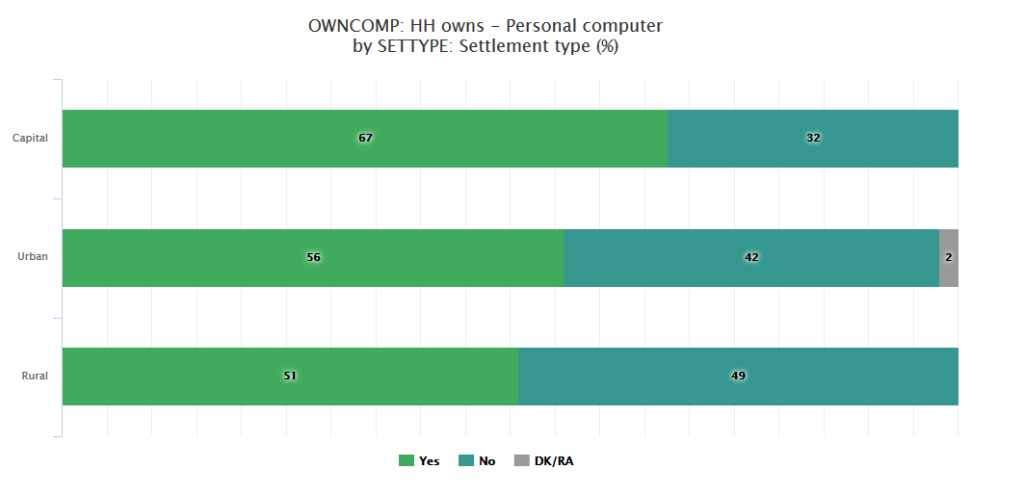
  • A third of Armenian homes have a personal computer.

Internet

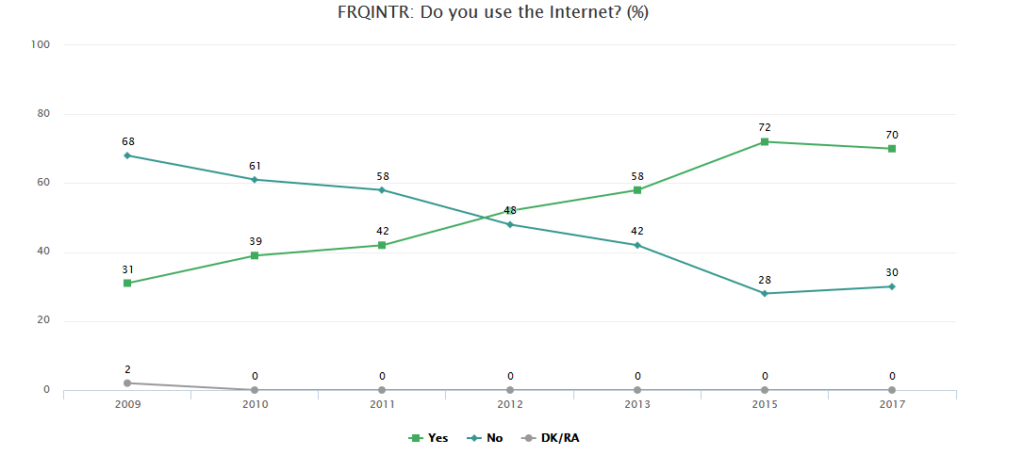
  • A quarter of Armenian households have Internet access.
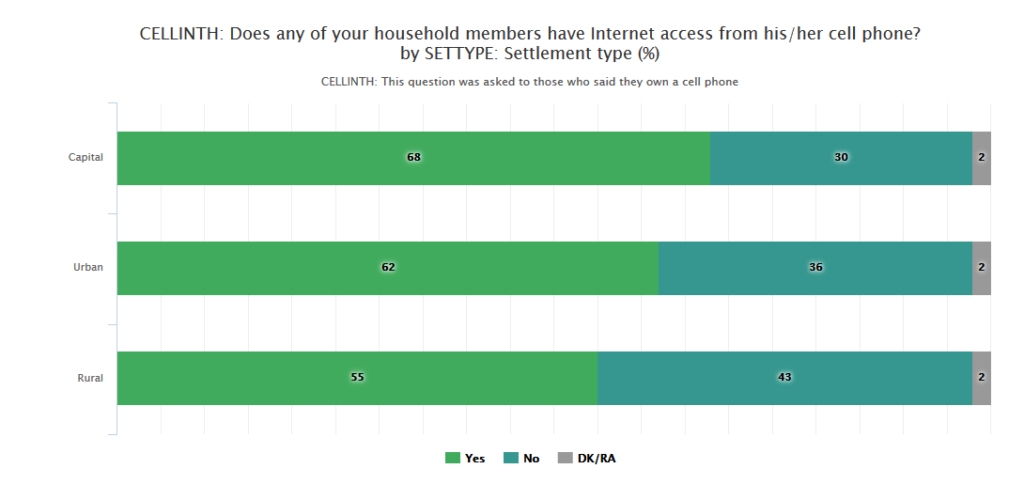
  • A third of Armenian Internet users use a 3G flash card to access the Internet.
  • Armenians use the Internet and social networking sites first for interpersonal communication.
  • Half of Armenian Internet users are on social networking sites, primarily Odnoklassniki, and many are on social networking sites daily.
  • Few Armenians use blogs, but those that do look to them for an alternative source of information and news.
  • 10% of Armenians use online video sites, mostly for music and entertainment content.
  • Rural, regional city, and Yerevan Internet use patterns greatly differ.

News consumption

  • Television is the most important source of news for Armenians, especially national TV stations, but they use multiple sources to draw conclusions.
  • While most Armenians do not use online news sites, those that do read them frequently and trust them highly.
  • Newspapers are not read by two-thirds of Armenians.
  • Armenians are mixed in their trust of the media, and most are unsure of the media’s independence from the government.
  • Armenians are very unsure how much freedom of speech exists for most media forms, but for those that are sure about television, their attitudes are mixed.
 

What do Armenians like about using the Internet?

In this analysis I’ve broken it down by primary Internet access device type. (This is January 2011 data from the ArMedia study.)

Interestingly, when asked the best attribute of the Internet, mobile-only users said connecting with friends (56%, while PC-only users said getting news and information (46%). Those that used both were split between these two attributes (38% connecting with friends, 38% getting news/information).

Get news/ info Share info about self Blog Connect w/ friends Comm w/ others Edu opps Operativity
1st best attribute of Internet
Mobile-only users 23% 0% 2% 56% 17% 5% 5%
PC-only users 46 1 0 22 7 12 12
Both mobile and PC 38 2 0 38 4 10 6
2nd best attribute of the Internet
Mobile-only users 17% 6% 0% 20% 33% 8% 8%
PC-only users 16 2 0 31 14 15 8
Both mobile and PC 23 2 0 29 21 8 10
3rd best attribute of the Internet
Mobile-only users 20% 12% 6% 6% 18% 15% 14%
PC-only users 14 4 3 12 13 20 13
Both mobile and
PC
13 4 0 29 21 8 10
 

Using the ARMedia dataset (report coming soon!), I was inspired to look at the demographic differences between users of Facebook and Odnoklassniki in Armenia. (Hat tip to Artur Papayan for inspiring the thought!)

ETA:
(In January 2011):
Percent of all Armenians that say that their most used social networking site is Odnoklassniki 17%
Percent of all Armenian Internet users that say that their most used social networking site is Odnolassniki 82%

Percent of all Armenians that say that their most used social networking site is Facebook 3%
Percent of all Armenian Internet users that say that their most used social networking site is Facebook 13%


(This is an except from my upcoming CRRC Armenia media report)

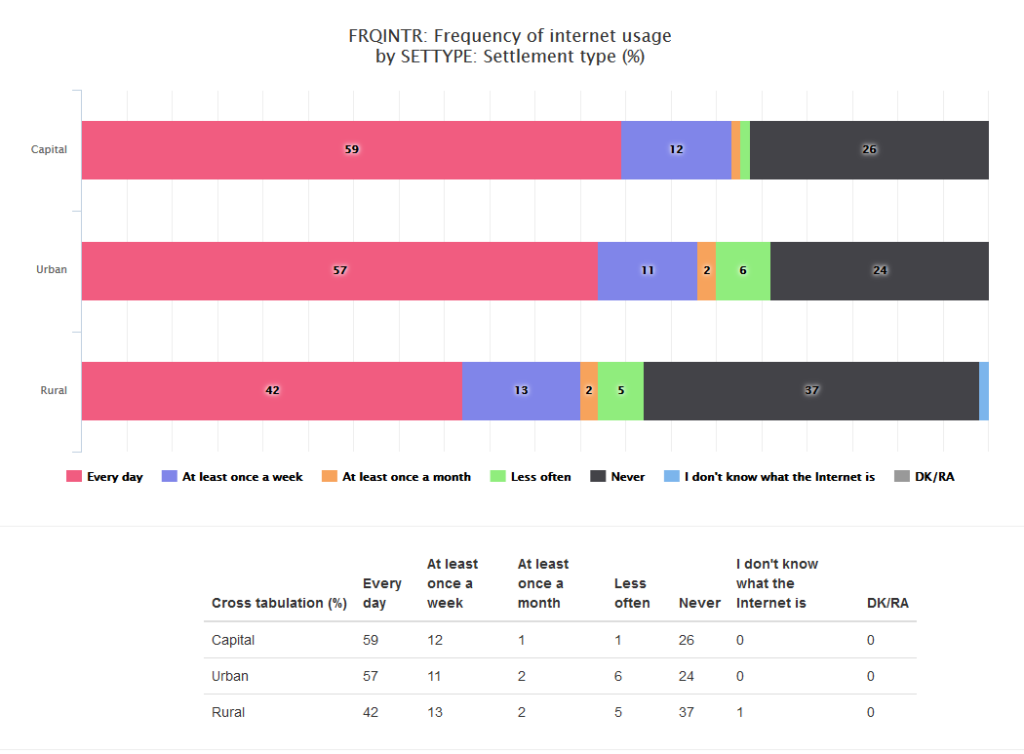
For the many Armenians that do not use the Internet (57% of Yerevan residents, 67% of regional city dwellers, and 86% of rural residents), the primary barrier is limited access to either a computer or a mobile phone (see Table below). The second most important reason is age, which 20% gave as an explanation for not using the Internet.

Reasons for not using Internet by settlement type (% of respondents, who don’t use the Internet)

Overall

Yerevan

Urban

Rural

Limited or no access to a computer/mobile phone

33

24

38

36

Age reasons/seniors

20

23

17

20

No interest

11

4

16

13

Not enough time

10

16

9

6

Internet or computer too difficult to use

8

9

6

10

No need/not useful

8

14

6

7

High prices for the Internet

7

8

5

8

Other

1

3

2

0

DK

0

 -

1

0


I’m working on a manuscript looking at poverty in the Caucasus. I noticed these interesting differences in what Armenians, Azerbaijanis, and Georgian say matters when trying to get a good job in their countries.

In all three countries both education and connections matter that most.

But take note that in Azerbaijan “doing favors for the right people” is the most important factor to 23% of respondents.

Other interesting differences include the greater importance of professional abilities in Georgia and appearance being more important in Armenia.

I’m not sure what the conceptual difference would be between connections and doing favors for the right people… but as far as I can tell, the two overlap a bit.


I’m working on a project right now looking at the relationship between English language proficiency and Internet use in the Caucasus.

Although wandering around Yerevan, Baku, or Tbilisi might tell you something different, English language proficiency in these countries is actually quite low.

Between 1-4% of the population considers themselves “advanced” in the English language and two-thirds to three-quarters have no proficiency whatsoever.

And despite conventional wisdom, it looks like there hasn’t been much growth in English proficiency since Caucasus Barometer started measuring it in 2007. And in Azerbaijan it seems to have gone down a little bit (out migration?).

What are the demographic characteristics that predict English language proficiency?

First, one’s education level (standardized beta .30) is the stronger predictor of English language proficiency.

Next is one’s urbanness. The more urban you are (capital, regional city, rural area), the more likely you are to know English (standardized beta .15).

Then one’s material deprivation (which means wealth/poverty). The wealthier you are, the more likely you are to know English (standardized beta .13).

Finally, gender matters. Women are more likely to know English (there is a lot of research on this and isn’t surprising) (standardized beta .07).

Age didn’t matter at all.


Since I posted a lot of analyses on economic wellbeing in the Caucasus, I thought that I’d put links to them all in one post.

Overall, I hope that this gives people a better sense of what dire poverty exists in all three states. If pressed, I’d say that based on these analyses, Georgia is doing the worst overall and Azerbaijan is doing the best. But without a doubt, there are more similarities in poverty in these three neighbors than there are differences.

Consumption ability
Consumption ability by capital/urban/rural

Income sources
Income distribution

Ownership of consumer goods

Food expenses
Borrowing money to buy food

Utilities

Debt and savings

Sanitation

Please feel free to ask questions or requests for further analysis.

© 2012 Katy Pearce Suffusion theme by Sayontan Sinha